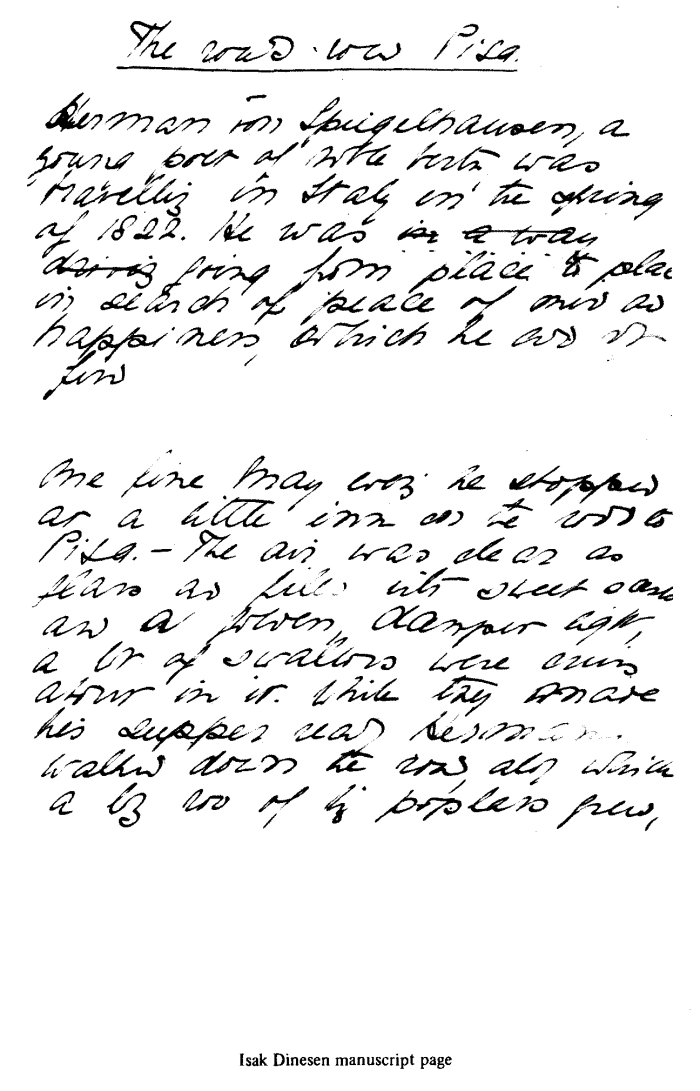
Issue 14, Autumn 1956
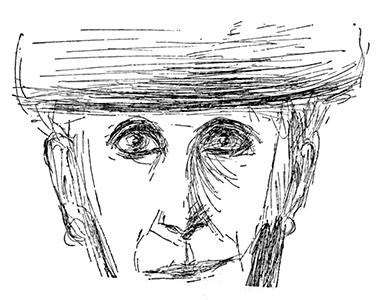 Illustration by Michael Batterberry, 1956.
It was, in a sense, type-casting when a few years ago a film was planned that would have shown us Garbo playing the role of Isak Dinesen in a screen version of Out of Africa, for the writer is, like the actress, a Mysterious Creature of the North. Isak Dinesen is really the Danish Baroness Karen Blixen, and she is the daughter of Wilhelm Dinesen, author of a classic 19th century work, Boganis’ Jagtbreve (A Hunter’s—or Sportman’s—Letters). Baroness Blixen has published under another name as well: a delightful novel (T_A___A___) she prefers not to acknowledge, though any reader with half an eye could guess the Baroness hiding behind the second, French, pseudonym. Literary circles buzz with legends about her: she is really a man, he is really a woman, “Isak Dinesen” is really a brother-and-sister in collaboration, “Isak Dinesen” came to America in the 70’s of the last century, she is really a Parisienne, she lives at Elsinore, she stays mostly in London, she is a nun, she is very hospitable and receives young writers, she is difficult to see and lives a recluse, she writers in French, no in English, no in Danish...
In 1934 the New York publishing house of Robert Haas and Harrison Smith (which was later absorbed by Random House) brought out a book called Seven Gothic Tales which Mr. Haas had accepted on first reading. The cool easy perfection of its prose and the ironical and fantastical tone of the stories made it an immediate success: a book club chose it, it became a best-seller, both the literature and semi-literate reviewers raved. And when that clamor was done the book was found to be still there: a great number of writers and painters were heard discussing it with great enthusiasm, always implying the book to be of that permanency usually labelled Standard Work. In 1937 Random House issued Out of Africa which is the diametrical opposite of the first work: where the Seven Gothic Tales are flights of pure imagination and impudent humor, Out of Africa is a sober and touching account of life on a coffee plantation in Kenya before, during, and after the First World War. It, too, established itself immediately as a work to which devoted readers returned for a second and third time. But only after Winter’s Tales had appeared in 1942, and when by then a new generation of readers had discovered the first book of tales, was the importance of these works generally determined. Outside the canon of modern literature like an oriole outside a cage of moulting linnets, Isak Dinesen offers to her readers the unending satisfaction of the tale told: “And then what happened?... well, then...” Her storyteller’s instinct coupled with the sophisticated simplicity of her style caused Ernest Hemingway, on receiving the Nobel Prize, to suggest it should have gone to Dinesen.
An official biography would read: born 18—at Rungsted, Denmark where she has always lived in an old house once an inn frequented by the poet Ewald, schooled at home, in Switzerland and England, travelled in Holland, France, Italy, married her cousin Baron Blixen in Mombasa and went to live with him in Kenya. Returned to Europe, after a long absence, in 1932, worked at writing and lived in Denmark since then. Has since visited Greece, France, England, Germany, Italy and other Scandanavian countries as well.
SCENE ONE
Rome, Early Summer, 1956. The first dialogue takes place in a sidewalk restaurant in the Piazza Navona, that long space, once flooded, where mock naval battles raged. The twilight is darkening the sky to an iris color and against it the obelisk that stands amidst Bernini’s fountain figures seems pale and weightless.
At a corner table sit Baroness Blixen, her secretary-traveling companion Clara Svendsen, and the interviewer. The Baroness is like a personage from one of her own tales. Slim, straight, chic, she is dressed in black, with long black gloves and a black Parisian hat that comes forward to shadow her remarkable eyes that are lighter in color at the top than at the bottom. Her face is slender and distinguished; around her mouth and eyes play the faint ghosts of smiles, changing constantly. Her voice is pleasing, being soft, but with enough force and timbre for one to hear at once that this is a lady with opinions both of grave profundity and of most enchanting frivolity. Her companion Miss Svendsen is a fresh-faced young person with a charming smile.
ISAK DINESEN
Interview? Oh, dear ... well, yes, I suppose so ... but not a list of questions or a third degree, I hope ... I was interviewed a short time ago ... terrible ...
MISS SVENDSEN
Yes, there was a man who came for a documentary film ... it was like a catechism lesson ...
DINESEN
Couldn’t we just talk together as we've been doing, you could write down what you like?
INTERVIEWER
Yes, then you could scratch out some things and scribble in others.
DINESEN
Yes. I ought not to undertake too much. I’ve been ill for over a year and in a nursing home. I really thought I should die. I planned to die, that is I made preparations, I expected to. I even planned a last radio talk ... I have made a number of radio talks on all kinds of subjects, in Denmark ... they seem to enjoy me as a radio speaker there ... I planned a talk on how easy it was to die ... not a morbid message, I don’t mean that, but a message of, well, cheer ... that it was a great and lovely experience to die. But I was too ill, you know, to get it done. Now, after being so long in the nursing home and so ill, I don’t feel I do really belong to this life. I feel that the world is happy and splendid and goes on, but that I’m not part of it. I’ve come to Rome to try and get into the world again. Oh, look at the sky now!
INTERVIEWER
Do you know Rome well? How long since you’ve been here?
DINESEN
A few years ago, when I had an audience with the Pope. I first came in 1912 as a young girl, staying with my cousin and best friend who was married to our Danish ambassador to Rome. We rode in the Borghese Gardens then, every day. There were carriages with all the great beauties of the day in them, and one stopped and chatted. It was delightful. Now look at these motors and motorbicycles and noise and rushing about. It’s what the young today want, though: speed is the greatest thing for them. But when I think of riding my horse—I always had a horse when I was a girl—I feel that something very precious is lost to them today. They aren’t acquainted with the elements or in touch with them. Everything is mechanical and urban: children are raised up without knowing live fire, living water, the earth. Young people want to break with the past, they hate the past, they don’t want to even hear of it, and one can partly understand it, the near past to them is nothing but a long history of wars, which to them is without interest. It may be the end of something, of a kind of civilization.
INTERVIEWER
But loathe leads to love: they may be led in a circle back to a tradition. I should be frightened of indifference more.
DINESEN
Perhaps. And I myself, you know, I should like to love what they love. Now, I love jazz. I think it’s the only new thing in music in my lifetime. I don’t prefer it to the old music, but I enjoy it very much.
INTERVIEWER
I really have about a million things I want to ask, if you permit. For instance, about T_A___A___.
DINESEN
(Laughing). Oh, that’s my illegitimate child! During the German occupation of Denmark I thought I should go mad with boredom and dullness. I wanted so to be amused, to amuse myself, and besides I was short of money, so I went to my publisher in Copenhagen and said, look here, will you give me an advance on a novel, and send me a stenographer to dictate it to? They said they would, and she appeared and I started dictating. I had no idea at all of what the story would be about when I began. I added a little every day, improvising. It was very confusing to the poor stenographer.
MISS SVENDSEN
Yes, she was used to business letters, and when she’d type the story from her shorthand notes, she’d put numbers sometimes, like “the 2 terrified girls” or “his 1 love.”
DINESEN
I’d start one day by saying “Then Mr. So-and-So entered the room,” and the stenographer would cry out, “Oh, dear, but he can’t. He died yesterday in Chapter Seventeen.” No, I prefer to keep T_A___A___ my secret.
INTERVIEWER
I loved it, and I remember it had excellent notices. Did many people guess that you had written it?
DINESEN
A few.
INTERVIEWER
And what about Winter’s Tales? That came out in the midst of the war—how did you get it to America?
DINESEN
I went to Stockholm—not in itself an easy thing to accomplish—and what was even more difficult took the manuscript with me. I went to the American embassy and asked them if they didn’t have planes going to the United States every day and if they couldn’t take the manuscript, but they said they only carried strictly political or diplomatic papers, so I went to the British embassy and asked them, and they asked could I supply references in England and I could (I had many friends in the Cabinet, amongst them Anthony Eden), so they cabled then said yes they could, so started the manuscript on its way to America.
INTERVIEWER
It seems a shame that the American Embassy couldn't have taken it.
DINESEN
Oh, don’t be too hard on them. I owe a lot to my American public. Anyway, with the manuscript I sent a letter to my American publishers just telling them that everything was in their hands and that I couldn’t communicate with them at all, and I never knew anything of how Winter’s Tales was received until after the war ended, when suddenly I received dozens of charming letters from American soldiers and sailors all over the world: the book had been put into Armed Forces Editions—little paper books to fit a soldier’s pocket. I was very touched. They sent me two copies of it; I gave one to the King of Denmark and he was pleased to see that, after all, some voice had spoken from his silent country during that dark time.
INTERVIEWER
And you were saying about your American public?
DINESEN
Yes, I shall never forget that they took me in at once. When I came back from Africa I had lost all the money I had when I married, because the farm didn’t pay you know. I asked my brother to finance me for two years while I prepared Seven Gothic Tales and I told him that at the end of two years I’d be on my own. When the manuscript was ready I went to England and one day at luncheon there was the Editor, Mr. Huntington, and I said “Please, I have a manuscript and I wish you’d look at it.” He said, “What is it?” and when I replied “A book of short stories,” he threw up his hands and cried “No!” and I begged “Won’t you even look at it?” and he said “A book of short stories by an unknown writer? No hope!” Then I sent it to America and it was taken right away by Robert Haas who published it, and the general public took it and liked it, and they have always been faithful. No, thank you, no more coffee. I’ll have a cigarette.
INTERVIEWER
Publishers everywhere are the traditional lament of the author.
DINESEN
The amusing thing is, that after the book was published in America, Huntington wrote to Robert Haas praising it, and begging for the address of the author, saying he must have the book for England. He had met me as Baroness Blixen, while Mr. Haas and I had never seen one another. He never connected me with Isak Dinesen. Later he did publish the book in England.
INTERVIEWER
That’s delightful; it’s like something from one of the tales.
DINESEN
How lovely to sit here in the open, but we must be going I think. Shall we continue our discussion on Sunday? I should like to see the Etruscan things at the Villa Giulia: we might chat a little then. Oh, look at the moon.
INTERVIEWER
Splendid. I’ll find a taxi.