Issue 30, Summer-Fall 1963
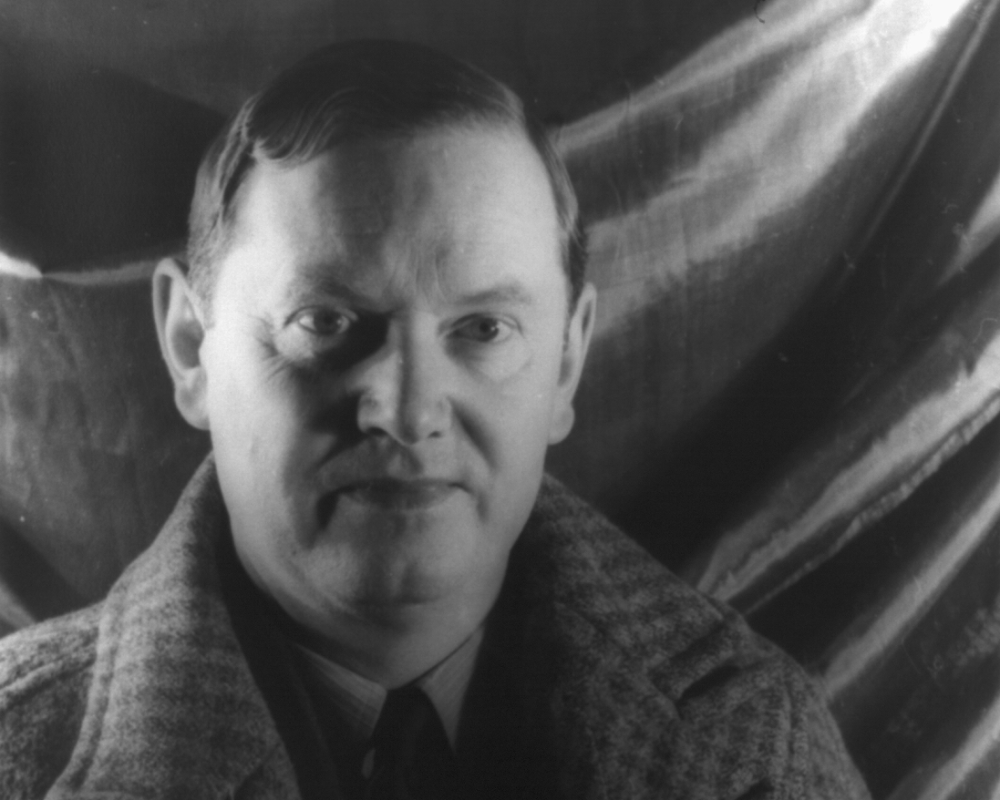 Evelyn Waugh, photograph by Carl Van Vechten.
The interview which follows is the result of two meetings on successive days at the Hyde Park Hotel, London, during April 1962.
I had written to Mr. Waugh earlier asking permission to interview him, and in this letter I had promised that I should not bring a tape recorder with me. I imagined, from what he had written in the early part of The Ordeal of Gilbert Pinfold, that he was particularly averse to them.
We met in the hall of the hotel at three in the afternoon. Mr. Waugh was dressed in a dark-blue suit with a heavy overcoat and a black homburg hat. Apart from a neatlytied, small, brown-paper parcel, he was unencumbered. After we had shaken hands and he had explained that the interview would take place in his own room, the first thing he said was, “Where is your machine?”
I explained that I hadn't brought one.
“Have you sold it?” he continued as we got into the lift. I was somewhat nonplussed. In fact, I had at one time owned a tape recorder, and I had indeed sold it three years earlier, before going to live abroad. None of this seemed very relevant. As we ascended slowly, Mr. Waugh continued his cross-questioning about the machine. How much had I bought it for? How much had I sold it for? Whom did I sell it to?
“Do you have shorthand, then?” he asked as we left the lift.
I explained that I did not.
“Then it was very foolhardy of you to sell your machine, wasn't it?”
He showed me into a comfortable, soberly furnished room, with a fine view over the trees across Hyde Park. As he moved about the room he repeated twice under his breath, “The horrors of London life! The horrors of London life!”
“I hope you won't mind if I go to bed,” he said, going into the bathroom. From there he gave me a number of comments and directions:
“Go and look out of the window. This is the only hotel with a civilized view left in London . . .. Do you see a brown-paper parcel? Open it, please.”
I did so.
“What do you find?”
“A box of cigars.”
“Do you smoke?”
“Yes. I am smoking a cigarette now.”
“I think cigarettes are rather squalid in the bedroom. Wouldn't you rather smoke a cigar?”
He reentered, wearing a pair of white pajamas and metal-rimmed spectacles. He took a cigar, lit it, and got into bed.
I sat down in an armchair at the foot of the bed, juggling notebook, pen, and enormous cigar between hands and knees.
“I shan't be able to hear you there. Bring up that chair.” He indicated one by the window, so I rearranged my paraphernalia as we talked of mutual friends. Quite soon he said, “When is the inquisition to begin?”
I had prepared a number of lengthy questions—the reader will no doubt detect the shadows of them in what follows—but I soon discovered that they did not, as I had hoped, elicit long or ruminative replies. Perhaps what was most striking about Mr. Waugh's conversation was his command of language: his spoken sentences were as graceful, precise, and rounded as his written sentences. He never faltered, nor once gave the impression of searching for a word. The answers he gave to my questions came without hesitation or qualification, and any attempt I made to induce him to expand a reply generally resulted in a rephrasing of what he had said before.
I am well aware that the result on the following pages is unlike the majority of Paris Review interviews; first it is very much shorter, and secondly, it is not “an interview in depth.” Personally, I believe that Mr. Waugh did not lend himself, either as a writer or as a man, to the form of delicate psychological probing and self-analysis which are characteristic of many of the other interviews. He would consider impertinent an attempt publicly to relate his life and his art, as was demonstrated conclusively when he appeared on an English television program, “Face to Face,” some time ago and parried all such probing with brief, flat, and, wherever possible, monosyllabic replies.
However, I should like to do something to dismiss the mythical image of Evelyn Waugh as an ogre of arrogance and reaction. Although he carefully avoided taking part in the marketplace of literary life, of conferences, prize giving, and reputation building, he was, nonetheless, both well informed and decided in his opinions about his contemporaries and juniors. Throughout the three hours I spent with him he was consistently helpful, attentive, and courteous, allowing himself only minor flights of ironic exasperation if he considered my questions irrelevant or ill-phrased.
INTERVIEWER
Were there attempts at other novels before Decline and Fall?
EVELYN WAUGH
I wrote my first piece of fiction at seven: The Curse of the Horse Race. It was vivid and full of action. Then, let's see, there was The World to Come, written in the meter of Hiawatha. When I was at school I wrote a five-thousand-word novel about modern school life. It was intolerably bad.
INTERVIEWER
Did you write a novel at Oxford?
WAUGH
No. I did sketches and that sort of thing for the Cherwell and for a paper Harold Acton edited—Broom, it was called. The Isis was the official undergraduate magazine: it was boring and hearty, written for beer drinkers and rugger players. The Cherwell was a little more frivolous.
INTERVIEWER
Did you write your life of Rossetti at that time?
WAUGH
No. I came down from Oxford without a degree, wanting to be a painter. My father settled my debts and I tried to become a painter. I failed as I had neither the talent nor the application—I didn't have the moral qualities.
INTERVIEWER
Then what?
WAUGH
I became a prep-school master. It was very jolly and I enjoyed it very much. I taught at two private schools for a period of nearly two years and during this I started an Oxford novel which was of no interest. After I had been expelled from the second school for drunkenness I returned penniless to my father. I went to see my friend Anthony Powell, who was working with Duckworth, the publishers, at the time, and said, “I'm starving.” (This wasn't true: my father fed me.) The director of the firm agreed to pay me fifty pounds for a brief life of Rossetti. I was delighted, as fifty pounds was quite a lot then. I dashed off and dashed it off. The result was hurried and bad. I haven't let them reprint it again. Then I wrote Decline and Fall. It was in a sense based on my experiences as a schoolmaster, yet I had a much nicer time than the hero.
INTERVIEWER
Did Vile Bodies follow on immediately?
WAUGH
I went through a form of marriage and traveled about Europe for some months with this consort. I wrote accounts of these travels which were bundled together into books and paid for the journeys, but left nothing over. I was in the middle of Vile Bodies when she left me. It was a bad book, I think, not so carefully constructed as the first. Separate scenes tended to go on for too long—the conversation in the train between those two women, the film shows of the dotty father.
INTERVIEWER
I think most of your readers would group these two novels closely together. I don't think that most of us would recognize that the second was the more weakly constructed.
WAUGH (briskly)
It was. It was secondhand, too. I cribbed much of the scene at the customs from Firbank. I popularized a fashionable language, like the beatnik writers today, and the book caught on.
INTERVIEWER
Have you found that the inspiration or starting point of each of your novels has been different? Do you sometimes start with a character, sometimes with an event or circumstance? Did you, for example, think of the ramifications of an aristocratic divorce as the center of A Handful of Dust, or was it the character of Tony and his ultimate fate which you started from?
WAUGH
I wrote a story called The Man Who Liked Dickens, which is identical to the final part of the book. About two years after I had written it, I became interested in the circumstances which might have produced this character; in his delirium there were hints of what he might have been like in his former life, so I followed them up.
INTERVIEWER
Did you return again and again to the story in the intervening two years?
WAUGH
I wasn't haunted by it, if that's what you mean. Just curious. You can find the original story in a collection got together by Alfred Hitchcock.